
How to choose a men's haircut for your face shape
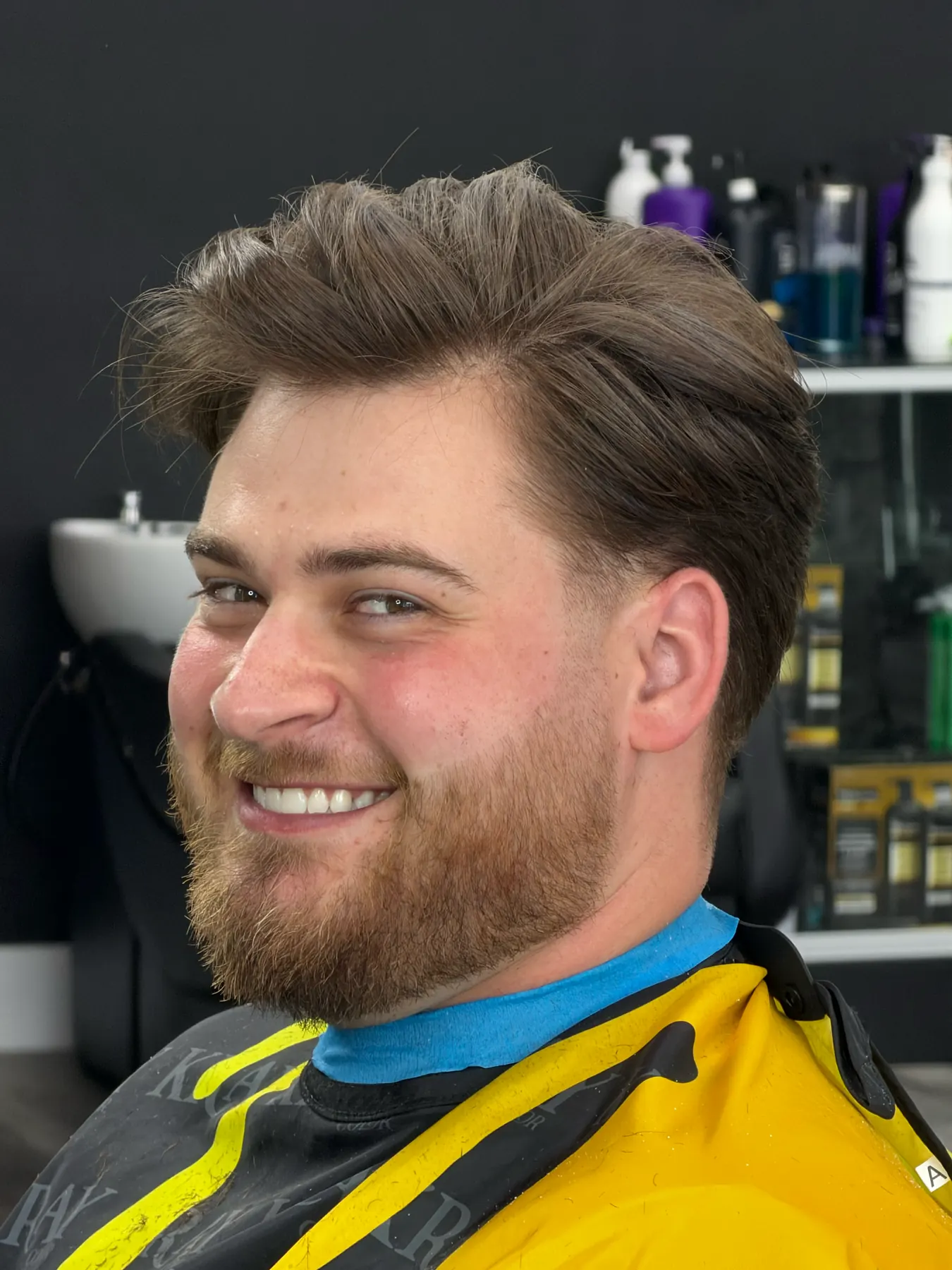
Two men can ask for the same haircut, sit in the same chair, and walk out looking like it worked for one of them and not the other. Nine times out of ten the hair was not the problem. The proportions were. Knowing how to choose a men's haircut for your face shape is the difference between a cut that flatters the head it is on and a cut that just happens to be in style.
The principle underneath all of it is simple, and it is the same one a tailor works to: balance. Every face is some distance from an oval, and a good haircut moves it back toward one. Where you leave weight, where you take it away, and where you put the hard line of a fade are the three levers you have.
Work out which face shape you actually have
Do this dry, in a mirror, with your hair pushed back off your forehead. You are comparing three measurements: the width of your forehead, the width of your cheekbones, and the width of your jaw — plus how the overall length compares to the widest of those three.
- Oval — length is noticeably greater than width, and the jaw is slightly narrower than the cheekbones. The forgiving one. Most things work.
- Round — length and width are close, the jawline is soft, and the widest point is the cheeks.
- Square — forehead, cheekbones and jaw are close to the same width, with a strong, angular jaw.
- Oblong or rectangular — like a square or oval, but noticeably longer than it is wide.
- Heart — a wide forehead narrowing to a fine, pointed chin.
- Diamond — narrow forehead and narrow jaw with wide cheekbones.
Most people are a blend of two, and that is fine. You are looking for the tendency, not a diagnosis.
What to ask for, shape by shape
Round. You want height and you do not want width. Ask for length left on top — a quiff, a pompadour, a textured crop with some lift — over short sides. A high fade or a hard part adds vertical line and visually lengthens the face. Avoid anything that leaves bulk over the ears; that is the exact place a round face does not need more of.
Square. You already have the angles, so the job is to not fight them. Short, clean sides and a moderate amount on top read well: crew cuts, buzz cuts with a shaped neckline, side parts. If the jaw is very heavy, softening the top with texture instead of a slick, blocky finish keeps it from tipping into severe.
Oblong or rectangular. The opposite of round — avoid extra height. Keep the top moderate and let a little more weight sit at the sides so the face reads wider. A low or mid taper does this better than a high skin fade. A full, well-shaped beard can shorten a long face; a long, pointed one makes it longer.
Heart. The width is at the top and the point is at the bottom, so you want to avoid piling volume above a narrow chin. Medium length with texture, a soft fringe, and sides that are not shaved to nothing all help. Beard growth along the jaw fills out the lower third.
Diamond. Add width at the forehead and the jaw and take it away at the cheekbones. A fringe, some fullness on top, and a taper rather than a tight skin fade at the cheek line.
Oval. Take your pick. Just do not add so much height that it turns oblong.
The other three things that decide it
Face shape is the loudest input, not the only one.
Your hairline. A receding or high hairline changes what a fringe can do for you and often makes a shorter, more textured crop the honest answer. Nothing is gained by cutting for a hairline you had five years ago.
Your hair type. Fine, straight hair will not hold a pompadour without daily work. Thick, coarse or curly hair resists being cut flat and will fight you at the sides. The right shape cut into the wrong hair type turns into a twenty-minute job every morning.
Your morning. This is the one people skip. If you spend four minutes on your hair, do not ask for a cut that needs twelve. Tell your barber the truth about it and the shape will be chosen to survive being ignored.
The conversation to have in the chair
Bring a photo — it is still the fastest way to close the gap between the haircut you are picturing and the one you describe. We wrote a whole piece on how to bring a photo to the barber, and the short version is: bring two or three of the same shape from different angles, and expect a straight answer about which parts of it will transfer to your head.
Then talk about the sides. Most of what people mean by "it didn't suit me" lives in how high the fade sat and how hard the line was. If you are not sure which end of that range you want, our guide to skin fades and taper fades covers the difference and the upkeep each one asks for.
And say the maintenance interval out loud. A shape that works on week one and collapses by week three is not the right shape for someone who books every five weeks.
Where we come in
At Fresh Cut Salon in Upper Arlington, the consultation is not a formality. We look at your head shape, your hairline and your growth pattern before a clipper comes out, and we will tell you if the cut you are asking for is going to fight your face rather than flatter it. You can see the range of work in the gallery, or read up on the barbers and book with whichever chair suits what you are after.
Choosing a men's haircut for your face shape is not about rules you have to obey. It is about knowing which lever to pull — and then having someone in the chair who can actually cut it.